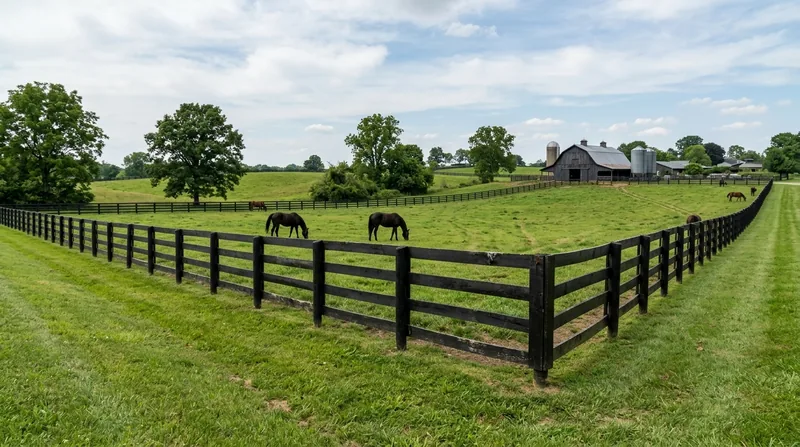




Farm fence installation in Lexington across the Bluegrass demands more than standard residential fencing. The rolling limestone plateau, shallow bedrock, and freeze-thaw winters that heave posts, combined with the region's iconic horse farms and working pastures, require fencing built to hold livestock, withstand weather, and work over terrain that shifts with the seasons. Whether you're fencing pasture for horses, cattle, or equipment storage, or replacing old field wire and pipe fencing that's weathered decades of Kentucky weather, we build fence lines that stay straight and gates that open reliably year after year.
Why Farm and Ranch Fencing Matters in Lexington and the Surrounding Counties
Fencing on acreage in Fayette, Scott, Woodford, Bourbon, Jessamine and Clark counties is not a subdivision project. Posts set in shallow rocky ground demand concrete footings and bracing at corners where livestock and wind put real load on the line. The iconic black-painted four-board plank fences and white vinyl privacy fencing you see along horse farms aren't just aesthetic; they're built to contain high-value animals, resist the corrosive effects of road salt near front pastures, and survive spring mud season when the clay stays soft and fence posts rot at the ground line. Field wire and pipe fencing for working pastures and equipment areas needs tension and anti-sag bracing to hold shape over rolling terrain.
- Four-board plank fencing holds horses and keeps sight lines clear across pasture.
- No-climb horse fence combines field wire with board framing to prevent hooves from catching.
- Pipe fencing and pipe gates handle heavy equipment and trailers without sagging or twisting.
- Post spacing, racking for slope, and concrete-set footings keep fence lines straight over rolling ground.
- Self-closing and self-latching hardware on gates prevents animals from pushing through and ensures gates stay secure in wind.
Proper farm fencing protects your investment, contains livestock safely, and holds its line through Kentucky winters and wet springs.
Key info: Horse farms across Lexington, Versailles and Paris rely on four-board plank fencing because it combines strength with the classic appearance that protects property values. Posts set 6 feet apart in concrete footings, with anti-sag bracing at corners, stand up to the freeze-thaw cycle and the weight of horses leaning on the rails.
See how gate installation and repair fits into a complete farm fencing system.
How We Build Farm and Ranch Fencing in Lexington: From Survey to Secure Gate
Every job starts with understanding your property line, terrain, and what the fence needs to hold. We work from your existing survey and install on the line you identify. Rocky ground and limestone outcrops are normal here; we dig post holes through them and set posts in concrete rather than tamping, because tamped posts heave in freeze-thaw cycles and fail within five years. Corners get braced with diagonal anti-sag members to handle wind and animal pressure. Gates are sized for the equipment and trailers that will pass through, with self-closing hardware that works reliably without adjustment.
- Locate utilities with a Kentucky 811 call before digging any post holes.
- Mark the fence line and identify terrain slope, rocky spots, and drainage patterns.
- Dig post holes to frost depth or into solid ground, setting posts in concrete with proper spacing.
- Install rails or field wire, racking the fence to follow slope so boards sit flush and wire stays taut.
- Add anti-sag bracing at corners and brace posts where the line changes direction.
- Hang gates with self-closing and self-latching hardware, and test for smooth operation and security.
This methodical approach ensures your fence line stays straight, gates operate reliably, and posts don't heave or rot prematurely.
Example: A 40-acre horse farm outside Nicholasville needed 1,200 linear feet of four-board plank fencing with two gates sized for trailers. Posts hit rock at 18 inches in most locations; we set them in concrete footings and braced the four corners where the line changed direction. The job took two weeks, and the fence has held straight through two winters and a spring flood season.
Learn more about fence post repair and replacement when existing posts fail.
Farm and Ranch Fencing Methods and Materials
| Approach | Description | Best for |
|---|---|---|
| Four-board plank | Pressure-treated pine or cedar boards, 2x6 or 2x8, set horizontally on posts spaced 6 feet apart. Posts set in concrete with diagonal bracing at corners. | Horse farms, high-visibility pastures, properties where appearance and strength matter equally. |
| No-climb horse fence | Field wire (typically 2x4 mesh or 2x6 mesh) installed in a frame of horizontal boards or pipe. Prevents hooves and legs from catching in wire. | Pastures with horses or ponies. Safer than bare field wire and reduces injury risk. |
| Pipe fencing | Galvanized or powder-coated steel pipe, typically 2-inch or 2.5-inch diameter, welded to posts or joined with slip fittings. Anti-sag bracing at corners. | Equipment storage, working pastures, areas where posts need to support heavy gates or withstand livestock pressure. |
| Split rail fencing | Rustic split cedar or pine rails set in notched posts. Lower cost per linear foot but less durable in wet ground and does not contain small livestock. | Decorative boundaries, pastures where containment is not the primary goal, properties with mature trees and aesthetic priorities. |
| Barbed wire fencing | Galvanized barbed wire strung on posts, typically 4 or 5 strands. Requires tension bands and stretcher bars to maintain tautness. Low initial cost. | Cattle pastures, working ranches, perimeter fencing where appearance is secondary to function and cost control. |
Each method balances cost, durability, aesthetics, and the specific livestock or equipment your pasture needs to contain. We help you choose the right approach for your terrain, budget, and long-term use.
Farm and Ranch Fencing Cost in Lexington: What to Expect
Farm fencing costs start at around $12 per linear foot for basic split rail or field wire fencing on level ground with easy post-hole access. Four-board plank fencing typically runs $18 to $28 per linear foot depending on wood species (pressure-treated pine versus cedar), rail size, and whether posts are set in concrete or tamped. Pipe fencing runs $20 to $35 per linear foot based on pipe diameter and whether the job requires welding or slip fittings. Gates add significantly to the project cost; a single 12-foot pipe gate with self-closing hardware can run $800 to $1,500 depending on design and materials.
Several factors move the price up from the starting point. Rocky ground and limestone outcrops require concrete footings and sometimes professional drilling, which adds labor and material cost. Slope and terrain racking (stepping or racking the fence to follow rolling pasture) requires more careful layout and custom rail cutting. Mature trees along the fence line may need to be worked around or removed. Access for equipment and crew, distance from the road, and whether the job requires utility locates or permits all affect the final number.
The best approach is to get two or three estimates from contractors who have built fencing in your specific area. A site visit lets us account for ground conditions, slope, and any obstacles before we quote. See our full pricing overview for additional detail on materials and labor.
Farm and Ranch Fencing Near Me: What Lexington Homeowners Should Know When Hiring a Contractor
Hiring the right contractor for farm fencing means checking three things: insurance coverage, permit requirements, and references from similar jobs in your area. Ask for proof of general liability and workers' compensation insurance; we can provide a certificate of insurance on request. Fence work in this state is not uniformly licensed at the state level; regulations vary by county and municipality, so check with your local building department in Lexington, Georgetown, Nicholasville, Winchester, Versailles, Paris, or Frankfort to learn whether your project requires a permit and whether a licensed general contractor is required above a certain contract value. Many master-planned communities and horse farms have HOA deed restrictions that govern fence height, materials, and color, so review your property documents before you start.
Ask potential contractors for references from farm fencing jobs they have completed in the past two years, and call at least two of them to ask about post durability, gate operation, and how the fence has held up through winter. A contractor who has built fencing over rocky ground and limestone in this region will understand the challenges and know how to set posts for the long term. Get the estimate in writing with a clear scope: linear footage, materials, post spacing, and gate specifications. Understand whether the price includes utility locates (required by Kentucky 811 before digging), permits, and site cleanup.
Call us at (859) 407-6106 for a free estimate and an honest assessment of what your property needs.
Farm & Ranch Fencing in Lexington: Pricing Guide
| Service | Price | Details |
|---|---|---|
| Split rail fencing | Starting at $12/ft | Rustic cedar or pine rails in notched posts. Cost increases on slopes or rocky ground requiring concrete footings. |
| Four-board plank fencing | Starting at $18/ft | Pressure-treated pine or cedar boards set horizontally. Concrete posts and anti-sag bracing at corners included. Rocky terrain adds 15-25% to labor. |
| No-climb horse fence | Starting at $16/ft | Field wire in board or pipe frame. Price varies by mesh size and whether posts are concrete-set or tamped in firm ground. |
| Pipe fencing with anti-sag bracing | Starting at $20/ft | Galvanized or powder-coated steel pipe, 2 to 2.5-inch diameter. Welding or slip fittings at corners. Concrete footings standard for all posts. |
| Farm gates (12-foot single swing) | Starting at $900 | Pipe or plank frame with self-closing and self-latching hardware. Larger gates or dual-swing configurations priced on estimate. |
| Estimate and site visit | Free | Response within 24 hours. No obligation to book. Includes assessment of terrain, utilities, and material recommendations. |
Indicative pricing, the exact cost depends on square footage, finish, and site access. Free personalized estimate within 24h at (859) 407-6106.


